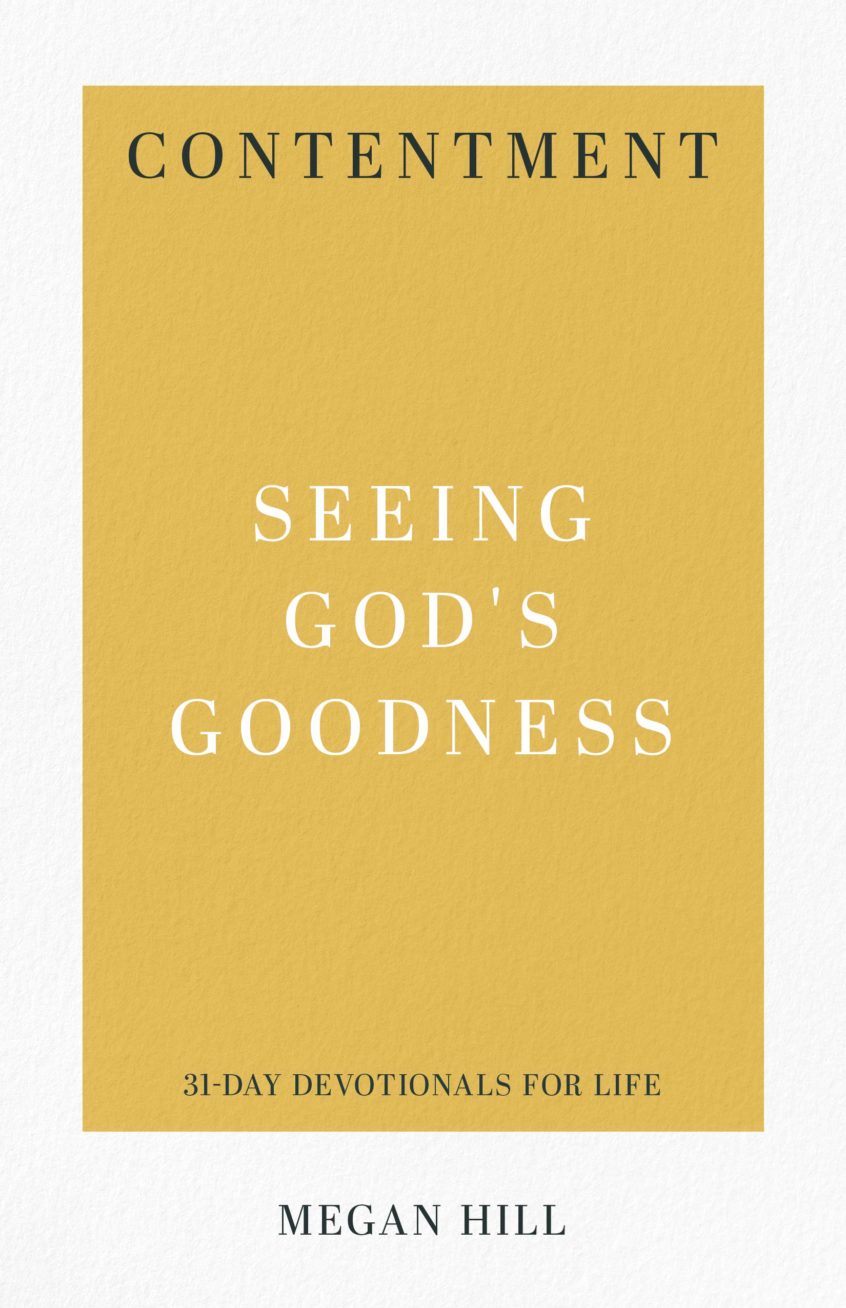
Contentment: Even for Christians, contentment may seem an impossible day-by-day reality. It’s so easy to slip into discontent, right?
My own quest for contentment prompted my purchase of Megan Hill’s Contentment: Seeing God’s Goodness right when P&R released it. Her 31 days of devotional readings and life application has helped me keep my focus on Jesus as our ultimate hope.
Get a taste of her book below in an excerpt, which appeared first here on The Biblical Counseling Coalition website. It is used with permission. (Edited for length.–LAM) HIGHLY RECOMMENDED

An Excerpt from Contentment
Discontent can strike at any time. On a Monday morning, the alarm goes off, and discontent is ready to pounce. Anything can invite an attack—a careless slosh from your coffee mug, a terse text from your spouse, a towering mountain of laundry on the basement floor—and you are frustrated with your life before you even walk out the door.
By the time the doctor’s office calls with your test results or the mail delivery brings a new round of bills, you are wishing for a new life entirely. Even something as simple as an unexpected rain shower can unleash thunderclouds in your heart. Just a few hours ago, you were joyfully worshipping God in the assembly of the saints at church and now you are thoroughly disappointed about how this same God is ordering events.
And it doesn’t stop there. Throughout our days, discontent waits for all of us. Whether we are young or old, alone or in a group, relaxing or working, we face circumstances that frustrate our expectations for what life should be like.
Worry
Once it takes hold of our hearts, discontent quickly leads to other sins. Because we fundamentally distrust what God is doing in and for us, our hearts give way to worry.
Every new circumstance feels surprising and potentially harmful. Everything from the flu to the presidential election brings an onslaught of uncertainty. We do not believe that God is caring for us, and we have little confidence that these events will be for our good, so our minds and hearts spin with anxiety.
Envy
Dissatisfied with our own situation, we look around at the lives of others and add the sin of envy. We covet the lives of our friends and neighbors—people who seem to have everything we want and more.
We also covet the lives of strangers—the happy couple with the gorgeous HGTV home or the alumnus whose fast-track career was lauded in the latest university publication. (And) we lust after their accomplishments or relationships or finances, increasing the discontent with our own.
Complaining
Frustrated and disappointed, we also fall into the snare of complaining. Seemingly every situation releases a sigh from our hearts.
The weather is too cold. The gray hairs too plentiful. The kids are too energetic. The pay is paltry, the hours over-long, the commute a total waste.
Like the Israelites in the wilderness, we give voice to our discontent with grumbling—accusing God of mishandling our lives and demanding that he give us what we want.
Discontent—and its evil companions—are everywhere.
Contentment Is Really Possible!
But if discontent waits just around the next corner, grace does too. At every moment, in every one of life’s circumstances, the Lord is ready with forgiveness (Neh. 9:7 ), encouragement (Rom. 15:5), strength (Phil. 4:13), and love (Rom. 8:38-39). The God who made you and sustains you is able to make grace abound to you for all things at all times (2 Cor. 9:8). In the fight against discontent, you are never alone.
I wrote Contentment: Seeing God’s Goodness because the temptation to discontent is common to all of us (1 Cor. 10:13). By the help of the Holy Spirit, we all—including me—need to rest content in God’s sovereignty over the circumstances of our lives. And it’s only when we look away from ourselves and our own circumstances that we can lay our eyes—and our hearts—on what truly satisfies: God and his good purposes.
This book was born in the midst of my own temptations to grumbling and anxiety. I wrote and edited while experiencing parenting challenges, relational disappointments, a leaking roof, an unexpected job change, and the daily repetition of dishes and laundry and dirty floors.
The Secret of Contentment
Not a day goes by that I don’t have to remind myself of the truth I wrote:
“The secret of contentment is not in having ‘enough’ money (or status or relationships or education). Rather, the secret of contentment is placing our ultimate hope in something secure:
The Lord will never leave us or forsake us; he is our help, so there is no reason to fear.”
Contentment: Seeing God’s Goodness can be purchased from Amazon.
 Megan Hill is a PCA pastor’s wife living in Massachusetts and an editor for The Gospel Coalition. She is the author of Contentment: Seeing God’s Goodness (P&R, 2018) and Praying Together (Crossway, 2016). This article is adapted from Contentment.